
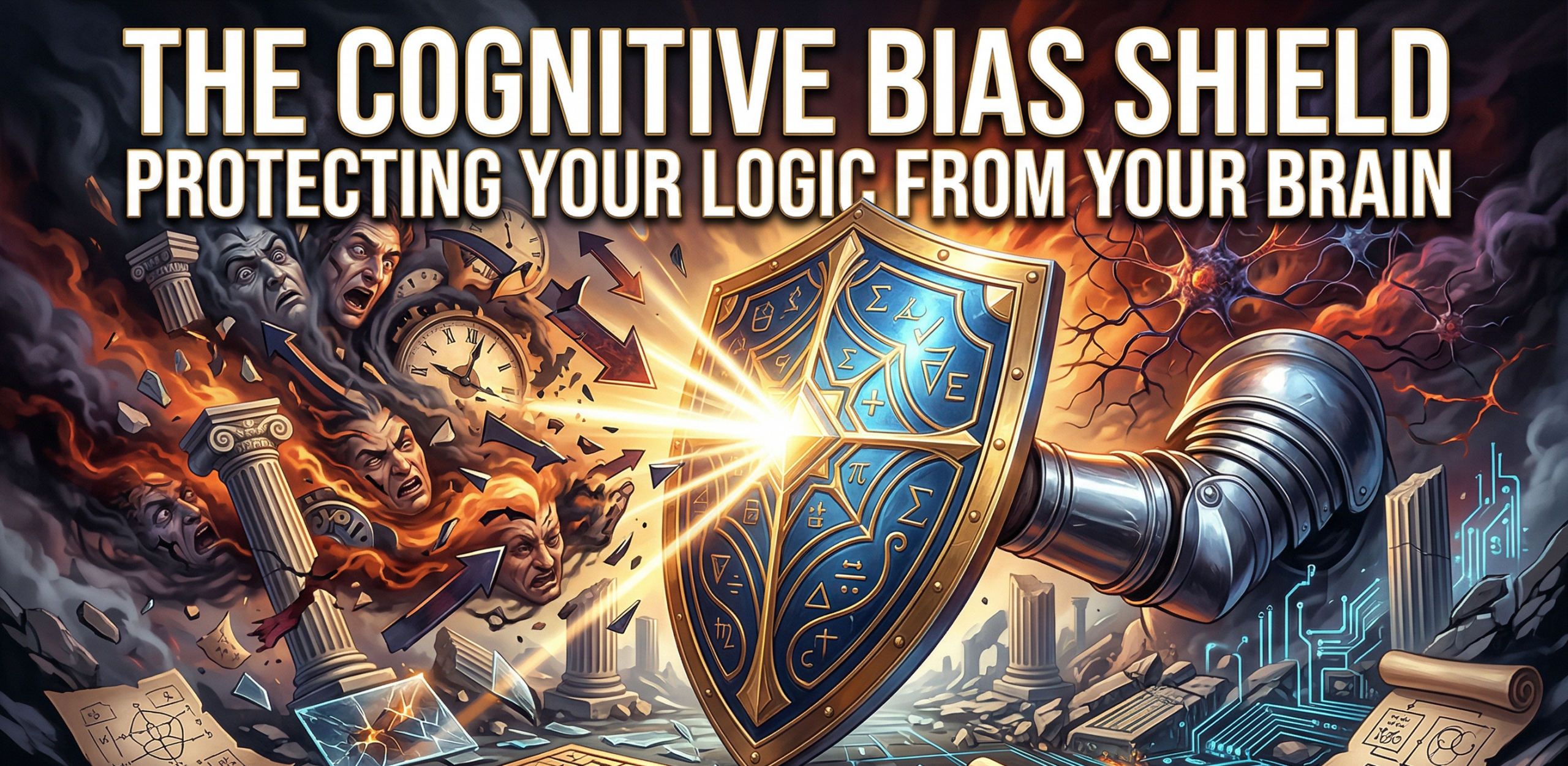
Your brain is a “Shortcut Machine.”
Evolution didn’t design your mind to be a high-precision supercomputer; it designed it to be a survival engine. On the savannah, a slow, logical analysis of a rustle in the grass meant death. You needed to make a split-second decision based on incomplete data. To do this, your brain developed Heuristics—mental shortcuts that allow you to process vast amounts of information instantly.
The problem? You no longer live on the savannah. You live in a world of complex data, high-stakes negotiations, and long-term strategic planning. Your “shortcuts” have become Cognitive Biases—predictable, systematic errors in thinking that cloud your judgment, drain your bank account, and sabotage your relationships. To win in 2026, you don’t just need a higher IQ; you need a Cognitive Bias Shield.
The Architecture of the Error: Why You Aren’t Rational
Psychologist Daniel Kahneman, a Nobel laureate, famously described our thinking as having two systems:
- System 1 (Fast): Intuitive, emotional, and automatic. It’s where your biases live.
- System 2 (Slow): Logical, effortful, and deliberate. It’s where your “Shield” lives.
Most of the time, System 1 is running the show, and System 2 is just the “press secretary”—its job is to come up with logical-sounding reasons for the irrational decisions System 1 already made. Mastering the “Shield” is the act of forcing System 2 to audit System 1.
1. The Echo Chamber (Confirmation Bias)
This is the mother of all biases. Your brain is wired to seek out, interpret, and remember information that confirms your existing beliefs. Conversely, it is wired to ignore or “debunk” information that challenges them.
If you believe a project will succeed, you will hyper-focus on the positive data points and dismiss the “Engine Warning” lights as anomalies. You aren’t seeing reality; you are seeing a “Highlight Reel” of your own opinions.
The Shield: Seek out “Disconfirming Evidence.” Ask yourself: “If I were wrong, what would the data look like?” Intentionally find the person who disagrees with you most and listen to them without the intent to reply.
2. The Anchor (Sunk Cost Fallacy)
Your brain has a “Loss Aversion” bug. It hates the feeling of “wasting” resources. This leads to the Sunk Cost Fallacy: the tendency to continue an endeavor (a failing project, a bad relationship, a stagnant career) simply because you’ve already invested time or money into it.
The “Anchor” is the past. But in logic, the past is gone. The only thing that matters is the future ROI. The Shield: Use the “Zero-Base” Test. Ask: “If I weren’t already in this situation today, knowing what I know now, would I choose to enter it?” If the answer is “No,” the only logical move is to cut your losses immediately.
3. The Recency Trap (Availability Heuristic)
We judge the probability of an event based on how easily we can recall an example. If you just read a news story about a plane crash, you feel like flying is dangerous, even though the statistical probability hasn’t changed.
In business, this means we over-weight the last 30 days of market data and under-weight the last 10 years of history. We react to the “Loudest” information, not the “Truest” information.
The Shield: Use Base Rates. Don’t trust your “feeling” about a trend. Look at the long-term averages. Ask: “Is this a fundamental shift, or am I just reacting to the most recent headline?”
4. The Confidence Gap (Dunning-Kruger Effect)
This is the bias that makes “beginners” feel like experts and “experts” feel like frauds. When you first learn a skill, your “Confidence” spikes before your “Competence” does. You don’t know enough to know how much you don’t know.
This leads to the “Confident Amateur” who takes massive, uncalculated risks, and the “Insecure Master” who hesitates to lead.
The Shield: Practice Intellectual Humility. If you feel 100% certain about a complex topic, you are likely at the “Peak of Mount Stupid.” The more you know, the more “nuance” you should see. If it feels simple, you’ve missed something.
Tactical Tool: The Pre-Mortem
The best way to deploy your Shield is the Pre-Mortem. Before launching any major initiative, gather your team and say:
“Imagine we are one year in the future. The project has failed spectacularly. It is a disaster. Now, tell me: What went wrong?“
This “Prospective Hindsight” bypasses the social pressure to be “positive” and allows System 2 to identify the “Blind Spots” that your biases were trying to hide. It turns “pessimism” into “strategy.”
The 30-Day “Bias Shield” Audit
This month, we are going to stop trusting our “Gut” and start auditing our “Process.”
- Week 1: The “Why” Check. Every time you feel strongly about a decision, find one piece of data that contradicts your position. Just one.
- Week 2: The Sunk Cost Purge. Identify one task or project you are doing purely out of “habit” or “loyalty to the past.” Stop doing it for seven days.
- Week 3: The Base Rate Review. When making a prediction about your work, ignore your “hunch.” Look up the historical data for similar projects. Does your “hunch” match the math?
- Week 4: The Humility Practice. Admit to a colleague or partner that you were wrong about a small detail. Notice how it doesn’t kill you—it actually increases your “Trust Surplus.”
The Final Clarity
The goal isn’t to be a “Perfect Thinker.” That’s impossible. Your brain will always try to take the shortcut.
The goal is to be a Skeptical Thinker. It’s the ability to pause, look at your own conclusion, and ask: “Is this the truth, or is this just the easiest story my brain could tell me?” The world is full of people who are “Certain.” Be the person who is Clear. The Shield is up. The data is in. Are you ready to see the reality, or do you just want to be right?
Which of these four biases—Confirmation, Sunk Cost, Availability, or Dunning-Kruger—do you think has been the “Quiet Saboteur” behind your biggest professional frustration this year?














Leave a Reply