
There is a subtle, nagging feeling that most of us carry through our professional and domestic lives.
It’s the feeling that you are “falling behind.” You look at your to-do list, your inbox, and your bank account, and you feel like a character in a movie who is constantly running but never actually arriving. You are productive, sure. You are meeting expectations. But you feel… thin. Like you’re being stretched over a life that doesn’t quite fit.
When this feeling hits, we are taught to look for “solutions.” We buy a new planner. We download a meditation app. We look for a “life hack” that will finally make the gears of our existence grind a little more smoothly.
But the real solution is often sitting in your garage, your sketchbook, or your kitchen.
Your passion projects—those “useless” things you do simply because you love them—are not distractions from your problems. They are the laboratory where your problems are actually being solved. While you think you’re just building a model, writing a story, or restoring a car, you are actually performing high-level psychological maintenance on your soul.
The Myth of the “Productive” Side-Hustle
We live in an era that tries to colonize every square inch of our joy.
The moment you show a modicum of talent for a hobby, someone—usually a well-meaning friend or a voice in your own head—asks: “Have you thought about selling these?” Or, “You should start a YouTube channel about this.”
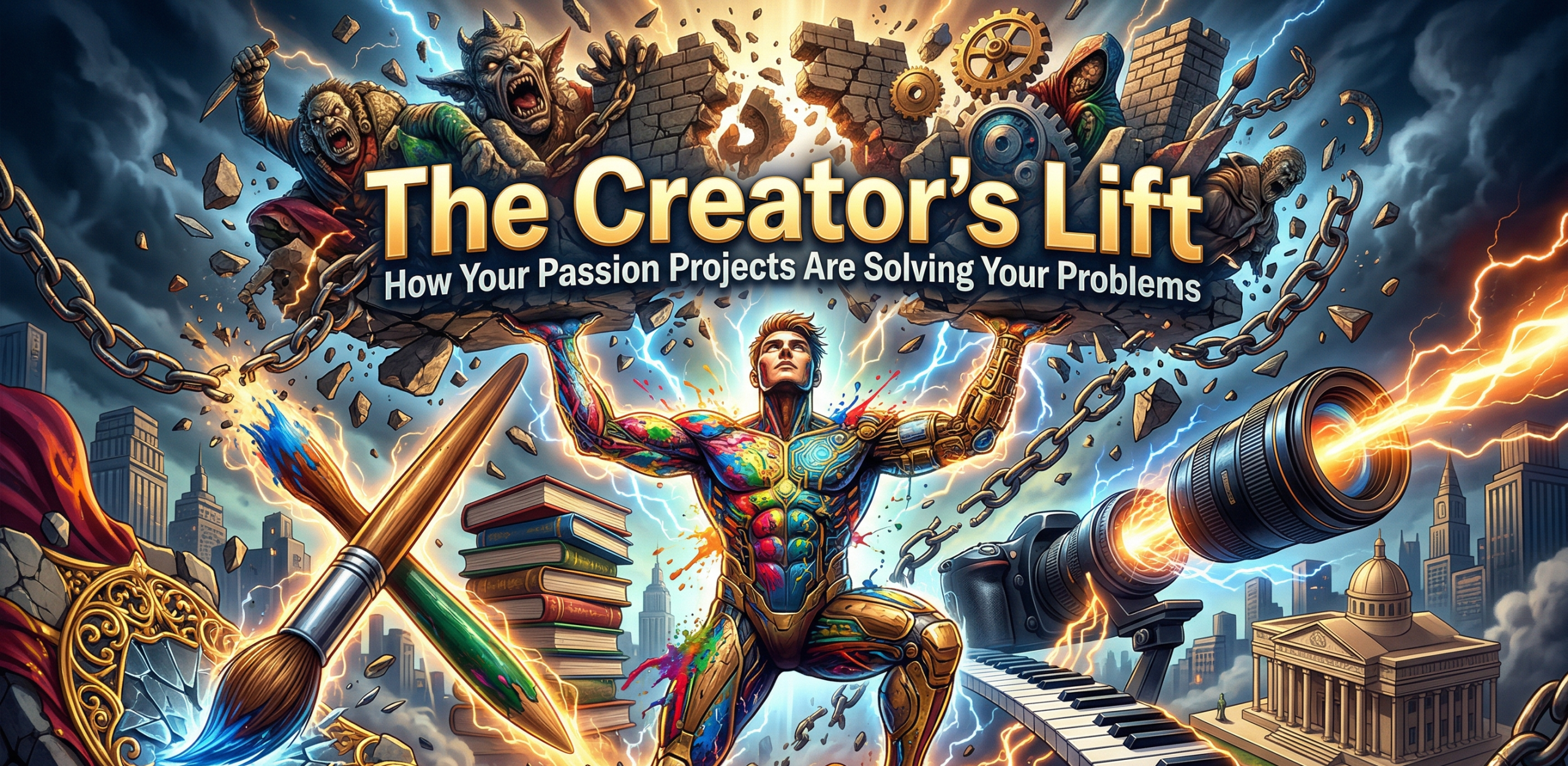
This is the fastest way to kill the “Creator’s Lift.”
The moment a passion project becomes a “hustle,” it inherits the very problems it was meant to solve. It gains a deadline. It gains a “market.” It gains the crushing weight of other people’s expectations. To get the psychological benefit of a passion project, it must remain sacred. It must be a space where your only boss is your curiosity.
When you create without the need to “convert,” you are practicing a rare form of mental freedom. You are telling the world that your time has value even if it doesn’t have a price tag.
Why Creativity is a Survival Mechanism
Most of the stress we experience in “real life” comes from a lack of control.
In your job, you can do everything right and still get laid off. In your relationships, you can be kind and still be misunderstood. The world is chaotic, unpredictable, and often indifferent to your effort.
A passion project is different. It is a world of your own making.
When you sit down to create, you are the absolute architect of the environment. You decide the parameters. You decide the goals. If something goes wrong, you are the one who fixes it. This isn’t just “fun”—it is a direct antidote to learned helplessness.
By regularly succeeding (and failing) in the controlled environment of a passion project, you are training your brain to believe in its own agency again. You are building the “muscle of influence.” When you return to the chaos of your daily life, you carry that sense of agency with you. You stop seeing yourself as a “victim of circumstances” and start seeing yourself as a “solver of problems.”
The “Project-to-Person” Pipeline
A passion project solves your problems by changing the person who has them.
Think about the last time you were stuck on a creative problem. Maybe the paint wouldn’t blend, or the code wouldn’t run, or the bread wouldn’t rise. You felt frustrated. You wanted to quit. But then, you tried one more thing. You looked at the problem from a different angle. You walked away, let your subconscious chew on it, and came back with a fresh perspective.
That process—Struggle, Pivot, Resolution—is a universal blueprint.
When you master that cycle in your hobby, you are creating a “mental shortcut” that your brain can use in your career.
- The resilience you built while learning to play a difficult song becomes the resilience you use during a tough negotiation.
- The attention to detail you developed while gardening becomes the focus you use while auditing a contract.
- The courage you found to share your “imperfect” art becomes the confidence you use to pitch a new idea at work.
Your project is the training ground. Your life is the stadium.
The 3 Pillars of the Creator’s Lift
To ensure your passion project is actually “lifting” you rather than just draining your time, it needs to hit three specific psychological markers.
1. The Cognitive Shift The project must be difficult enough to require your full attention. If it’s too easy, your mind will wander back to your “real world” worries. If it’s too hard, you’ll get discouraged. The “Lift” happens in that middle ground where you are so engaged that the rest of the world effectively ceases to exist.
2. The Tangible Result In a digital economy, our “wins” are often invisible. We close tickets, send emails, and move numbers on a screen. A passion project should ideally result in something you can touch, see, or hear. This “Sensory Evidence” is vital for the brain. It provides a level of satisfaction that a “good performance review” simply cannot match.
3. The Freedom to Fail This is the most important pillar. Your passion project must be a “consequence-free zone.” You must have the right to produce something objectively terrible. When you remove the fear of failure, you unlock the ability to innovate. You start taking risks that you would never take in your “professional” life—and those risks are often where the biggest personal breakthroughs happen.
Reclaiming the Word “Amateur”
We’ve turned the word “amateur” into an insult. We use it to mean someone who isn’t good at what they do.
But the root of the word is the Latin amator, which means lover. An amateur is someone who does something for the love of it.
When you embrace being an amateur, you are reclaiming your humanity. You are stepping out of the “performance” and into the “experience.” You are allowing yourself to be a whole person, rather than just a specialized tool for someone else’s profit.
The Creator’s Lift isn’t about becoming a master artist or a world-class maker. It’s about using the act of creation to remind yourself that you are still the one holding the brush.
The 30-Day Project Protocol
If you feel “stuck,” “burnt out,” or “uninspired,” don’t look for an exit. Look for a project.
- Week 1: The Permission Slip. Identify one thing you want to make “just because.” Buy the supplies. Tell yourself, out loud, that it is okay if the result is total garbage.
- Week 2: The Focused Hour. Spend three one-hour sessions with your project. No phone. No music. Just the work. Notice how your brain tries to “sneak back” to your worries—and gently pull it back to the task.
- Week 3: The Problem-Solving Phase. You will hit a wall this week. Good. Don’t look up the answer immediately. Sit with the frustration. Try three “wrong” things before you look for the “right” one.
- Week 4: The Celebration of the Imperfect. Finish the project. Don’t hide it, but don’t feel the need to “post” it for validation either. Look at what you made. Realize that 30 days ago, it didn’t exist. And neither did the version of you that knows how to make it.
The Final Transformation
You aren’t just making a thing. The thing is making you.
Every hour you spend in your passion project is an investment in your mental sovereignty. It is a “buy-back” of your own attention.
The problems in your life might not disappear while you’re creating, but something better happens: they get smaller. They lose their power to define you. Because you’ve reminded yourself that you are a creator, a builder, and a solver.
Stop waiting for the “right time” to start. The lift is waiting for you. Pick up the tools. The solve is in the making.






Leave a Reply