
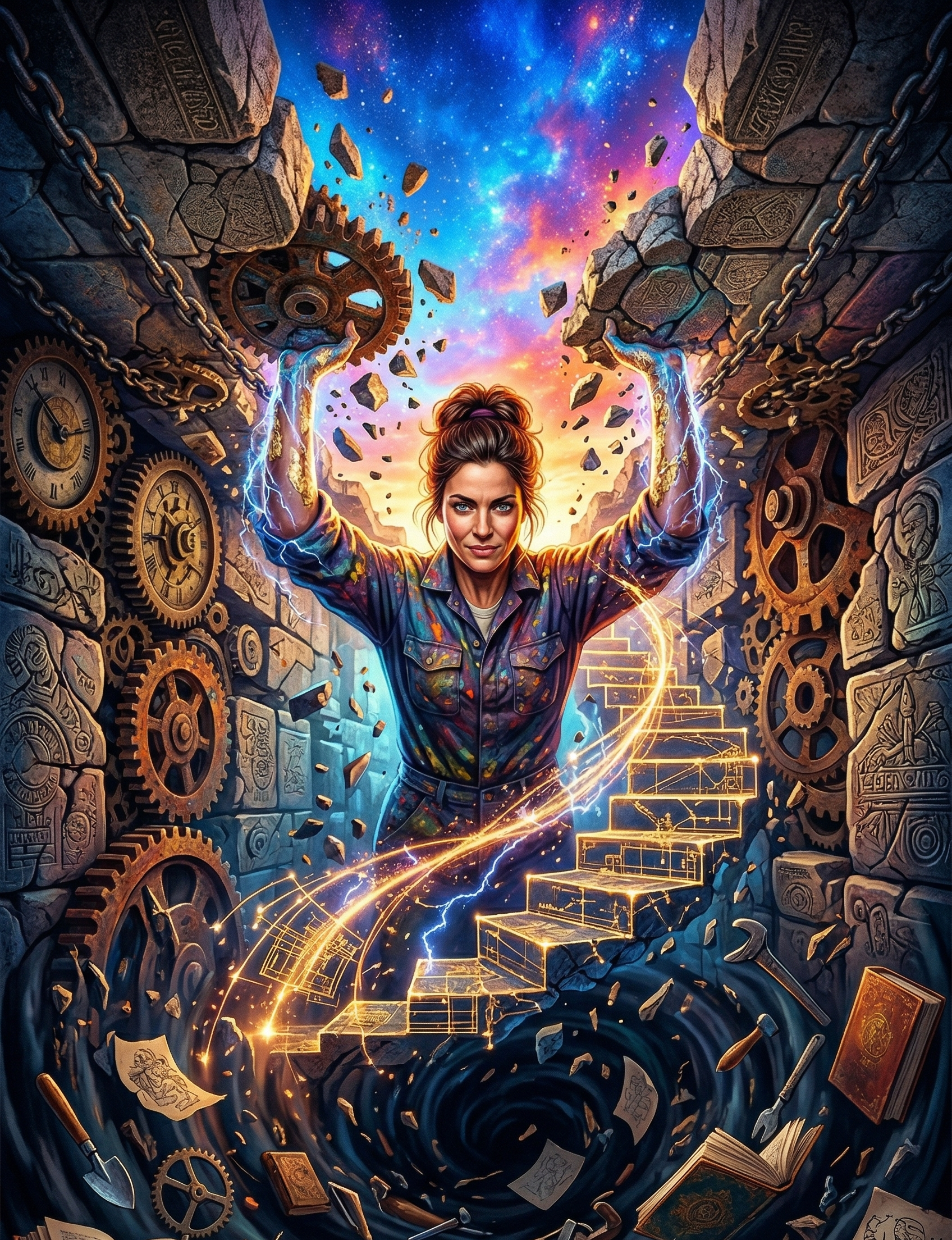
We’ve been sold a version of “self-care” that is remarkably passive.
We’re told that to care for ourselves, we need to retreat. We need the bubble bath, the scented candle, the expensive spa day, or the mindless Netflix marathon. We are taught that the antidote to a stressful, demanding world is to simply stop moving. To become a consumer of comfort.
But have you ever noticed that after a weekend of “passive” self-care, you often feel more sluggish than when you started?
The “rest” didn’t actually restore you. It just numbed the noise for a few hours.
True self-care isn’t about escaping your life; it’s about rebuilding your capacity to live it. And there is no more potent way to do that than by leaning into the “mess” of learning a new skill.
Skill-building is the ultimate self-care because it replaces the feeling of being “spent” with the feeling of being “built.”
The “Stagnation Stress” Nobody Talks About
Most of the burnout we feel isn’t just from working too hard. It’s from working on things that don’t belong to us.
When your entire day is spent responding to other people’s priorities, your sense of agency begins to erode. You feel like a passenger in your own life. This creates a specific kind of psychological friction called “Stagnation Stress”—the quiet anxiety that comes from knowing you aren’t evolving.
Passive self-care doesn’t fix this. It just puts the anxiety on “pause.”
Skill-building, however, is a direct attack on stagnation. Whether you are learning to bake sourdough, code a website, or speak a new language, you are reclaiming your time. You are telling your brain: “I am still a work in progress. I am still capable of expansion.”
That realization is more restorative than any spa treatment.
Why the “Mess” is the Medicine
Most people quit a new hobby or skill the moment it gets frustrating. They hit the “Messy Middle”—that period where they have enough knowledge to know they are bad, but not enough skill to be good.
They think the frustration is a sign that they should stop. They think they’ve failed at “self-care” because it doesn’t feel relaxing.
But the frustration is exactly where the healing happens.
When you struggle with a new skill, your brain is forced to create new neural pathways. This process—neuroplasticity—requires focus and effort. In that focused state, the “rumination loops” of your daily stress are physically unable to run. You can’t worry about your mortgage while you’re trying to figure out the timing of a complex guitar chord.
The “mess” isn’t a distraction from the care. The “mess” is the care. It is a forced meditation that clears the mental slate through active engagement rather than passive avoidance.
The Dopamine of Progress vs. The Sedative of Comfort
There are two types of “feel-good” chemicals our brains hunt for.
Passive self-care chases Serotonin and Endorphins—the chemicals of safety, comfort, and relaxation. These are valuable, but they are fleeting. They are sedatives.
Skill-building chases Dopamine—the chemical of pursuit and reward.
When you finally master a technique that felt impossible yesterday, your brain releases a surge of dopamine that reinforces your sense of competence. This isn’t just a “mood boost.” It is an identity shift. You go from feeling like a “victim of your schedule” to feeling like a “master of a craft.”
Competence is the most underrated form of mental health.
When you know you can learn, adapt, and improve, the challenges of your professional and personal life feel less like threats and more like puzzles.
The 3 Pillars of Skill-Based Self-Care
To turn skill-building into a restorative practice, you have to approach it with a specific psychological framework.
1. The “Low-Stakes” Environment The skill must be entirely disconnected from your income or your status. If you start worrying about how to “monetize” your pottery, it stops being self-care and starts being “Work 2.0.” Keep the stakes at zero. Give yourself permission to be spectacularly mediocre.
2. The Incremental Win The brain doesn’t need a massive victory to feel restored; it needs a visible one. Break your skill down into “micro-skills.” Don’t try to “learn Italian”; try to learn five verbs today. Those small, undeniable wins create a “Success Loop” that counters the “Failure Loop” of a stressful job.
3. The Tactile Connection In a digital world, we are increasingly disconnected from the physical results of our labor. We move pixels and send emails. Choosing a skill that involves your hands—painting, gardening, mechanics, cooking—grounds you in reality. It provides “Sensory Feedback” that a screen cannot replicate.
Embracing the Plateau
Every skill has a plateau. A week where you don’t seem to get any better.
In a “Productivity Mindset,” a plateau is a waste of time. In a “Self-Care Mindset,” a plateau is a sanctuary.
It is the time when your brain is solidifying what it has already learned. It is a period of “maintenance.” If you can learn to enjoy the plateau—to keep showing up even when there isn’t a “breakthrough”—you are developing the ultimate life skill: Resilience.
You are learning to be okay with the quiet, slow work of growth. You are learning that you don’t need to be “optimizing” every second to be valuable.
The 30-Day Skill Shift
If you feel “burnt out,” stop trying to relax. Try to grow.
- Week 1: The “Messy” Start. Pick one thing you are objectively bad at but curious about. Spend 20 minutes a day just making a mess. No tutorials yet. Just play.
- Week 2: The Structured Struggle. Watch one video or read one chapter. Try to replicate a specific technique. Feel the frustration? Good. That’s your brain updating.
- Week 3: The Tangible Output. Aim for one “Finished” thing. A messy loaf of bread. A shaky recording of a song. A poorly knitted scarf. The quality doesn’t matter; the existence of the object does.
- Week 4: The Identity Reflection. Look back at Day 1. You are no longer the person who “couldn’t do this.” You are now the person who “is learning this.” Feel the difference in your confidence.
Beyond the Bubble Bath
Self-care is a discipline, not a luxury.
It is the discipline of protecting your potential from being smothered by your obligations.
By choosing to build a skill, you are choosing to invest in the only asset that can never be taken away from you: your ability to change.
Stop looking for the exit. Start looking for the tools. The joy isn’t at the finish line.
The joy is right there in the middle of the mess.






Leave a Reply